
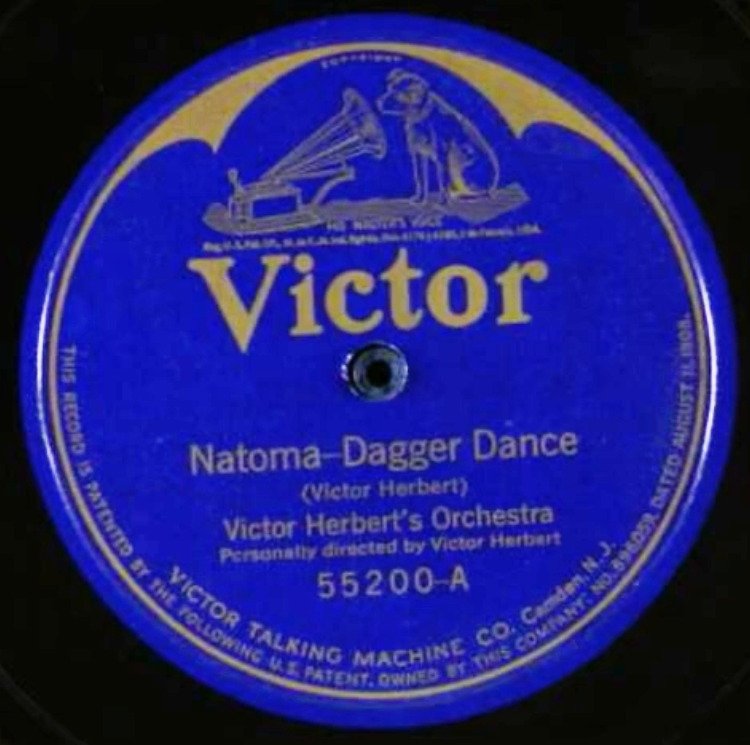
“Natoma – Dagger Dance” (1923) – Victor Herbert’s Orchestra

“Natoma-Dagger Dance” (1923) – Victor Herbert’s Orchestra * Label: Victor 

More about that Hamm’s Beer “Land of Sky Blue Waters” theme that Los Lobos referenced in “Las Amarillas”: It uses the title, but nothing else, from a 1909 Charles Wakefield Cadmon song later recorded by the Andrews Sisters and others. Moira F. Harris, in her The Paws of Refreshment: The Story of Hamm’s Beer Advertising (2000), writes that the Minneapolis Campbell-Mithun ad agency devised it, with lyrics by Don Graewert and orchestration by Ernie Gavrin of WCCO radio. 

Other influences included the lyrical cadence of Longfellow’s Song of Hiawatha, Haitian voodoo drumming, western movie soundtrack tropes, and the “dagger dance” from American light music composer Victor Herbert’s Natoma. Although operettas were Herbert’s forte, this was one of only two forays he made into grand opera, and it wasn’t a hit. With a libretto by Joseph D. Redding, it told the story of a Chumash maiden and her daughter, both of whom get tangled in situations with non-Chumash love interests in old Santa Barbara, California.

You can hear the Hamm’s Beer melody rolling around here, later to be tightened up into an unforgettable jingle aimed at football and baseball fans from the 1950s to the 1980s. You can also hear it near the beginning of “Natoma: Selections,” helpfully attended to by the Slovak Radio Symphony Orchestra for the Naxos American Classics series. The Orchestra, though, never touched anything by Czech-American Rudolf Friml, whom several online sources credit erroneously as the composer of Natoma.
“Las Amarillas” (1988) – Los Lobos

“Las Amarillas” (1988) – Los Lobos * Produced by Los Lobos * Label: Slash/Warner Bros. 

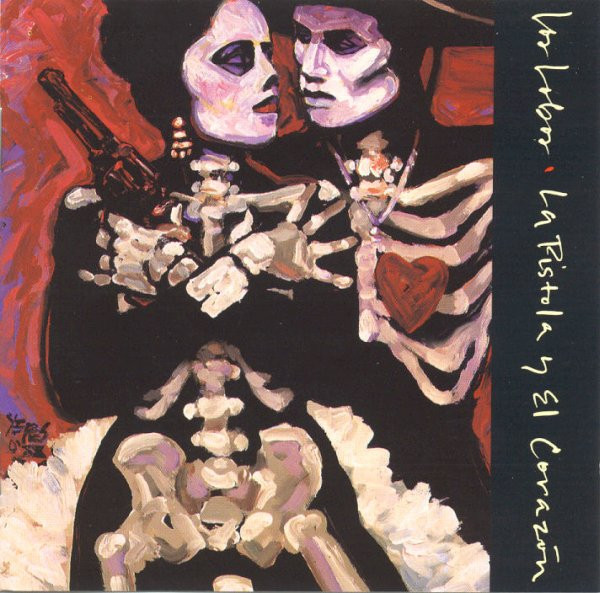
Los Lobos topped the charts in 1987 with their polished-up vintage T-bird version of “La Bamba.” Perhaps drawing inspiration from the scene in the eponymous movie where Ritchie Valens hears the song’s traditional incarnation (performed by Los Lobos as a late fifties cantina band), they went unplugged for their follow-up album La Pistola y El Corazon, a nine-song folklorico album that clocked in at only twenty-five minutes and featured striking cover art by George Yepes.

Seven of the tracks are traditional, while the other two are trad-sounding originals. The best information you can get about the album is in the February 1989 issue of Frets magazine, in which the band gives background on each of the songs and their instrumentation.

Cesar Rosas identifies “Las Amarillas” as a primitive huapango from the backwoods of Guerrero, where “you use a drum instead of a bass, two nylon-string guitars, and two violins.” In a 1988 review of the album in the Los Angeles Times, Victor Valle writes that the song “goes into a territory of passion some Mexicans may not even recognize,” with “allusions to beaks that peck and nests that squeeze,” giving Rosas’ vocal “the earthy eroticism of Campesinos ignorant of puritanical shame.”

Not mentioned anywhere is the song’s coda, where Louie Perez’s floor toms shift into a pulsing 4/4, David Hidalgo plays the Native-American signifier riff of old westerns on his violin, and band roadie Mouse de la Luz, on bells, sounds out the melody to the Hamm’s Beer “Land of Sky-Blue Waters” theme. 


“In a Big Country” (1983) – Big Country

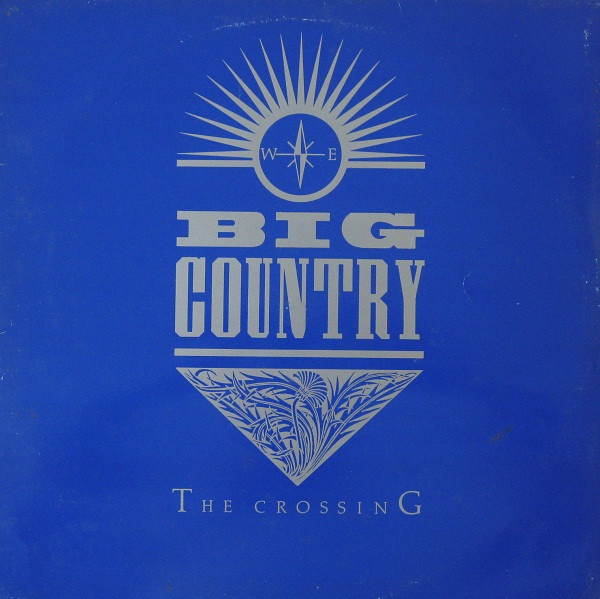
“In a Big Country” (1983) – Big Country * Written by Stuart Adamson, Mark Brzezicki, Tony Butler, and Bruce Watson * Produced by Steve Lillywhite * LP: The Crossing * Label: Mercury * Charts: Billboard Hot 100 (#17), UK Singles (#17) (numerologists take note)

Amid the foggy synths and posh vocals American radio listeners heard in those days, it was likely the guitar bagpipes of Scotland’s Big Country that declared with highest certainty that a British Invasion was on. So distinctive were the twin skirls of Stuart Adamson and Bruce Watson, as showcased on their radio hit “In a Big Country,” that they could have copyrighted the approach. (What is Adamson shouting throughout the song? “Shout,” apparently. But it always sounded to me like “Ciao, hot shot.”)

Theirs was an era when male pop and metal bands alike attempted to out-girl each other in appearance, but Big Country, in their plaid button-downs, offered up a comparatively blokey and earnest middle ground. Their sound was big, too—producer Steve Lillywhite’s extended version of “In a Big Country” was less a dance mix than a muscle mix, ultimately receiving the most airplay and being the one they included on their debut album. 

Big Country’s widely viewed music video, which presented the band giving chase to a young woman across pastoral, cottage-dotted landscapes, attempted to undermine any of the music’s muscularity with visual tweeness. Image example 1: The band riding three-wheelers with helmetssensible and safe but not rock and roll. Image example 2: All four of them getting knocked over like bowling pins by one female. Image example 3: The band darting across the water in an air-pump boat. 

The outdoorsy video images would have worked fine, say, for a Hamm’s Beer “Land of Sky Blue Water” ad campaign. And listeners didn’t need to listen closely to the lyrics to surmise that a positive evocation of well-being was at work. But a close listen reveals them to be rather poetic words of encouragement having the power to ease pain and change a life.

Stuart Adamson sang these in 1983, but ended his own life after struggling with alcoholism and depression in 2001, a tragedy that gives “In a Big Country” a poignancy that one hopes will continue affecting people for the better.

As part of the song’s ongoing legacy, I offer up my own experience of seeing Big Country playing live at a small-ish venue in 2013 with Mike Peters (of The Alarm) handling lead vocals. This was a remarkably big-hearted performance, after which all band members passed the mic around to express personal thanks. (Joining guitarist Bruce Watson on the twin guitar attack was his son Jamie.)  Peters is a survivor of lymph cancer and chronic lymphocytic leukemia, and it wasn’t until I heard him deliver the “stay alive” refrain as an outright exhortation (“Stay alive!”) that I fully grasped the song’s power a full thirty years after I first heard it.